
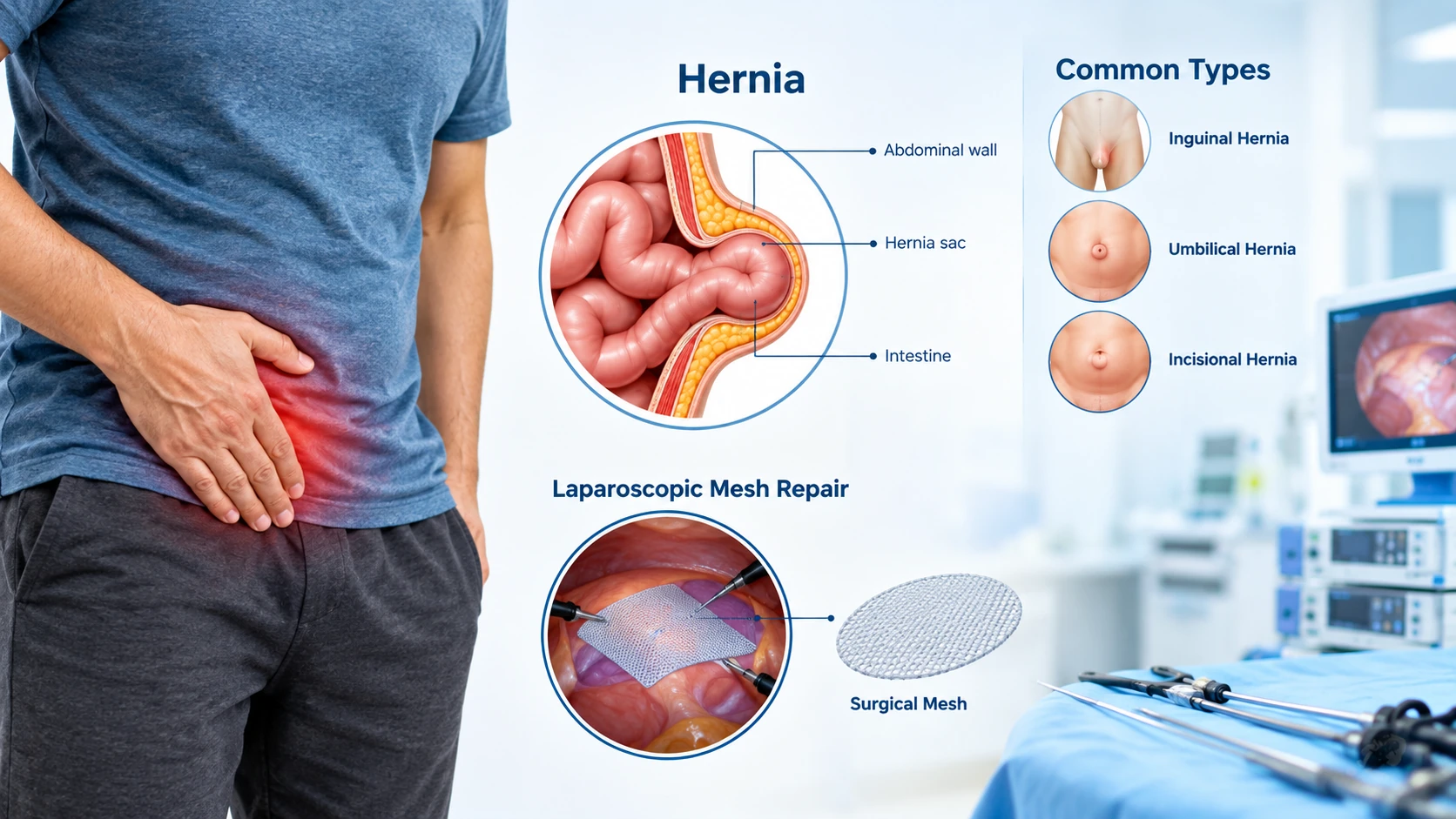
A hernia is one of the most common surgical conditions encountered in clinical practice, affecting both men and women of various age groups. A hernia occurs when an internal organ or fatty tissue pushes through a weakness or tear in the surrounding muscle wall or connective tissue fascia. Most frequently, hernias develop in the abdominal wall and groin area, presenting as a noticeable bulge or lump.
While many hernias start as painless swellings, they represent a mechanical defect in the muscle layer that never resolves on its own. Understanding the symptoms, potential complications, and timely surgical intervention available at Karthikeya Speciality Clinics helps patients prevent sudden medical emergencies and regain complete physical strength.
Common Types of Hernias
Hernias are classified according to the anatomical location where the protrusion develops:
- Inguinal Hernia (Groin Hernia): The most common form, accounting for approximately 75% of all abdominal wall hernias. It occurs in the groin area when intestinal tissue pushes through the inguinal canal. Inguinal hernias are significantly more prevalent in men.
- Umbilical Hernia: Occurs around the navel (belly button) when abdominal contents protrude through a weak spot in the abdominal wall. This is frequently observed in infants, post-pregnancy women, or individuals with chronic abdominal pressure.
- Incisional Hernia: Develops at or near the site of a prior surgical scar where the abdominal wall muscles did not heal completely or weakened over time.
- Femoral Hernia: Appears slightly lower than an inguinal hernia, deep in the upper thigh/groin canal. While less common, femoral hernias carry a higher risk of strangulation and are more frequent in women.
- Epigastric Hernia: Occurs in the midline of the upper abdomen between the breastbone (sternum) and the navel, often containing fatty tissue.
Recognizing Symptoms and Warning Signs
In the early stages, a hernia may be small and cause minimal discomfort. However, as the muscle defect enlarges, patients often notice distinct physical changes:
- A visible bulge or protrusion that becomes more prominent when standing, coughing, straining, or lifting heavy weights.
- A bulge that softens or disappears completely when lying flat on your back (reducible hernia).
- A dull ache, heaviness, or burning sensation in the lower abdomen or groin towards the end of the day.
- Localized discomfort when bending over, coughing, or engaging in strenuous physical activity.
Why Early Surgical Evaluation is Essential
The primary concern with an untreated hernia is the risk of acute strangulation:
- Incarceration: The protruding bowel loop or fatty tissue becomes trapped inside the opening and cannot be pushed back into the abdomen.
- Strangulation: The blood supply to the trapped tissue is choked off. This is a severe surgical emergency causing intense pain, tissue necrosis (gangrene), nausea, vomiting, and fever requiring immediate emergency intervention.
Elective surgery planned under experienced surgical care eliminates this emergency risk entirely, allowing for smooth, planned recovery under ideal conditions.
Advanced Laparoscopic (Keyhole) Hernia Repair
At Karthikeya Speciality Clinics, hernia repairs are performed using advanced, minimally invasive laparoscopic techniques (such as TEP – Totally Extraperitoneal and TAPP – Transabdominal Preperitoneal repair):
How Laparoscopic Mesh Repair Works
- Three tiny keyhole incisions (ranging between 5mm to 10mm) are made in the abdominal wall, eliminating the need for large traditional cuts.
- A high-definition laparoscope and specialized instruments gently reduce the herniated organ back into its natural anatomical position.
- A lightweight, medical-grade prosthetic mesh is placed across the entire weak area. The mesh acts as a sturdy structural scaffold, distributing tension evenly across the abdominal wall and drastically reducing the risk of recurrence.
Key Advantages Over Traditional Open Surgery
- Significantly less postoperative pain and discomfort
- Minimal blood loss and negligible scarring
- Shorter hospital stay (often discharged within 24 to 48 hours)
- Faster return to office work, driving, and routine physical activities (typically within 7 to 10 days)
- Ability to repair bilateral (both left and right side) hernias through the exact same tiny incisions
What to Expect: Preparation and Post-Surgery Recovery
Before Surgery
Your surgeon will assess the size and reducibility of the hernia through a clinical examination and an ultrasound scan of the abdomen or pelvis. Routine pre-anesthesia blood tests, ECG, and chest X-rays are completed to ensure optimal safety.
Post-Operative Recovery Timeline
- First 24–48 Hours: Gentle walking is encouraged within hours of surgery to promote circulation and bowel motility. Soft diet is resumed the same evening.
- Week 1: Most desk jobs, computer work, and light household chores can be resumed comfortably. Avoid lifting heavy objects (>5 kg) and prevent constipation by drinking adequate fluids and eating dietary fiber.
- Week 4–6: Abdominal wall strength continues to consolidate as natural collagen incorporates into the mesh. Strenuous workouts, weightlifting, and sports may be safely resumed after your surgeon's clearance.
Frequently Asked Questions (FAQs)
Can a hernia go away without surgery?
No. A hernia is a structural gap in the muscle wall. While symptoms may fluctuate, the defect never closes on its own and will gradually enlarge over time without surgical repair.
Is the mesh safe to remain inside the body?
Yes. Modern surgical meshes are made of inert, biocompatible materials (such as polypropylene) that have been rigorously proven over decades of clinical use. The body's natural tissue grows into the mesh pores, creating a durable reinforcement.
How do I know if my hernia is an emergency?
If your hernia suddenly becomes extremely painful, turns firm, red or dark in color, and you develop nausea, vomiting, or inability to pass gas or stool, seek immediate medical care at an emergency surgical facility.
How can I consult Dr. Malyadri Paladugu for hernia evaluation?
You can schedule an in-person consultation with senior surgeon Dr. Malyadri Paladugu at Karthikeya Speciality Clinics, located beside Vijetha Super Market on Bollaram Road, Bachupally, Hyderabad. Clinic consultations are available daily from 6:00 PM to 9:00 PM. Call +91 79957 56828 or visit our Contact Page to confirm your appointment token.